
Commemorating Juneteenth
Juneteenth, also known as Freedom Day, commemorates the emancipation of the last enslaved people under the U.S. Confederacy on June 19, 1865. On this day, we are reminded of the resilience and strength of the Black community.
However, Juneteenth also stands as a reminder that, more than 160 years later, the fight for collective liberation against systemic racism and inequities is not over.
In 2026, the U.S. still upholds a criminal system built on the same exploitation and dehumanization faced by enslaved people in the past.
A Foundation for Exploitation
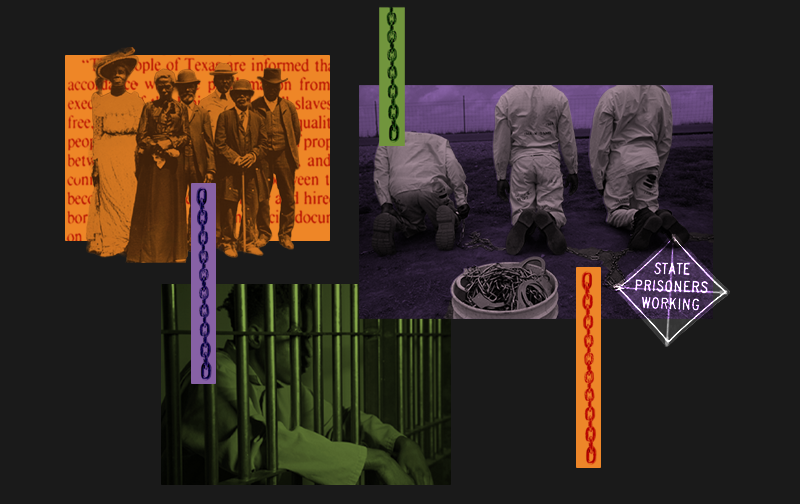
Although Congress passed the 13th Amendment in January 1865, it was ratified in December 1865 to explicitly exclude those convicted of a crime from legal protection against enslavement and involuntary servitude.
Southern states began using this exception to maintain control over the newly freed Black population and effectively re-enslave them. States began creating new types of offenses, called “Black codes,” that encouraged the incarceration of Black individuals based on arbitrary and disproportionately enforced laws.
The ratification of the 13th Amendment and the subsequent criminalization of Black people laid the framework for exploitation and modern-day enslavement in the U.S. prison system.
Forced Prison Labor
The Black community’s struggle for freedom and the struggle for prisoners’ rights has been connected since enslavement was abolished. In the U.S., there are large disparities in sentencing decisions, with Black Americans being incarcerated in state prisons at nearly five times the rate of white Americans.
In 2022, more than 76% of incarcerated workers reported they were forced to work—for little to no pay—or face punishment, such as solitary confinement. Incarcerated individuals are also not given basic workplace protections, including safety guarantees, even though many are forced to work dangerous jobs, such as cleaning up hazardous spills and responding to earthquakes, fires, and other disasters.
In 2025, more than 1,000 incarcerated individuals were among the personnel deployed to fight the destructive Palisades and Eaton fires.
Incarcerated people make up 30% of all wildland firefighting crews in California, fighting dangerous fires in 24-hour shifts for as little as $2.90 a day.
Advocating for Incarcerated Populations
CAIR-CA has historically advocated for the rights of incarcerated people by supporting critical legislation, including:
- Assembly Bill 32 (2019), which prohibits the Department of Corrections from contracting private, for-profit prisons to incarcerate people in California.
- Senate Bill 309 (2023), which secured the right to religious headwear, clothing, and grooming for those in California prisons and jails.
- Proposition 6 (2024), which aimed to remove involuntary servitude as a punishment for crime from California’s Constitution—although it ultimately failed to pass.
- AB 2599 (2026), which, if passed, would require companies of a certain value that contract with or operate in the state to disclose whether their company or related entities owned, sold, or otherwise participated in enslavement-related transactions.
CAIR-CA is also looking to hire a full-time advocate to ensure carceral facilities are complying with their legal obligations toward incarcerated Muslims across California. Click here to apply for the
Our Commitment to Justice for All
Today, and every day, CAIR-CA remains committed to fighting systemic inequities, dismantling racial barriers, and striving toward justice, dignity, and freedom for all.
Sources: American Civil Liberties Union, KQED, The Sentencing Project, Vera Institute of Justice


