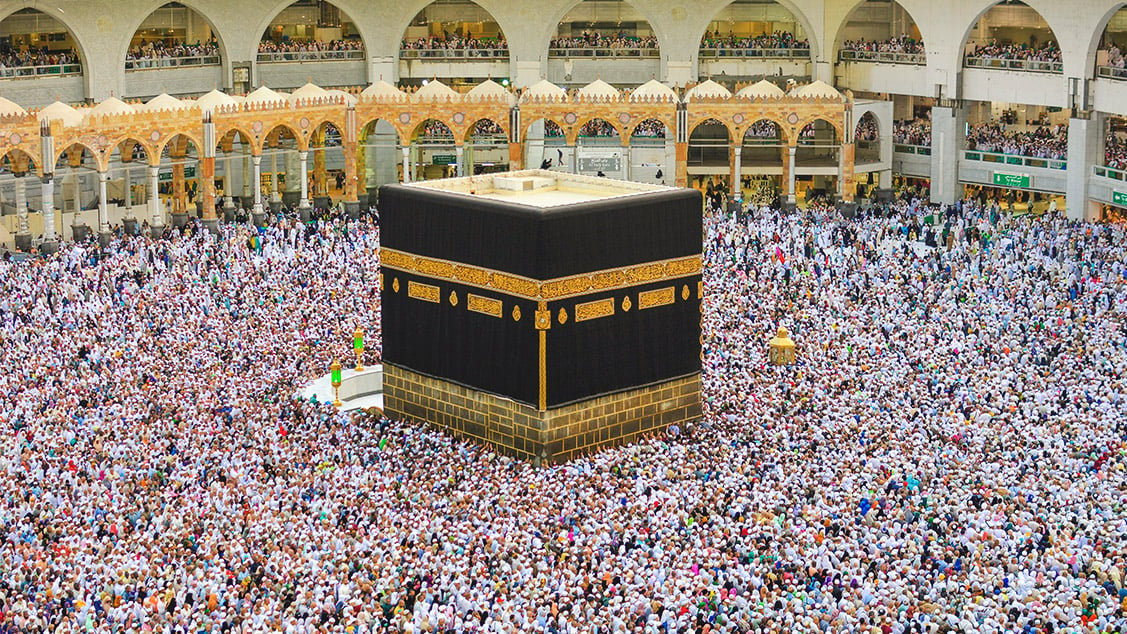
Photo: Courtesy of Visit Saudi
(LOS ANGELES, CA – 6/3/2025) – On Friday, June 6, American Muslims plan to mark the end of Hajj, the yearly pilgrimage to Mecca, with the celebration of Eid ul-Adha (EED-al-ODD-ha), or “festival of the sacrifice,” at locations around the country.
Eid ul-Adha, commonly referred to as just “Eid,” commemorates the Prophet Abraham’s willingness to sacrifice his son Ishmael at God’s command. The holiday is celebrated with communal prayers, small gifts for children, distribution of meat to the needy, and social gatherings. During this holiday, Muslims exchange the greeting “Eid Mubarak” or “blessed Eid.”
[NOTE: For actual pilgrims, the rites of Hajj continue for some time after the Eid prayers. Eid al-Fitr, which marks the end of the month-long fast of Ramadan, is the other of the two “Eid” holidays Muslims celebrate each year.]
WHEN: Friday, June 6. The prayers are held in the morning. Many communities also hold day-long Eid festivals for families.
WHERE: The Eid prayers and festivals are held either in local mosques or in public facilities designed to accommodate large gatherings. Contact your local CAIR chapter or other Muslim organizations for details about Eid celebrations.
PHOTO OPPORTUNITY: Each year at Eid ul-Adha, American Muslim families attend prayers and celebrations. Many places of prayer organize children’s activities. The prayers themselves are quite visual, with worshipers arranged in neat rows and bowing in prayer in unison. Participants exchange embraces at the conclusion of the prayers.
[NOTE: Because this is a religious service, reporters and photographers of both sexes should dress modestly. Photographers should arrive early to get into position for the best images. Photographers are also advised not to step directly in front of worshipers and to seek permission for close-ups.]
HAJJ BACKGROUNDER:
In the Quran, Islam’s revealed text, God says: “Thus We settled Abraham at the site of the House [the Ka’aba] [saying]: ‘Do not associate anything with Me, and purify My house for those who walk around it, and those who stand there [praying], and those who bow down on their knees in worship. Proclaim the pilgrimage among mankind: they will come to you on foot and on every lean [beast of burden]; Let them come from every deep ravine, to bear witness to the advantages they have, and to mention God’s name on appointed days.” (Chapter 22, Verses 26–28)
Hajj is one of the “five pillars” of the Islamic faith. (The other pillars include a declaration of faith, daily prayers, offering regular charity, and fasting during the month of Ramadan.) Pilgrimage is a once-in-a-lifetime obligation for those who have the physical and financial ability to undertake the journey.
When the main portion of the pilgrimage is completed, Muslims worldwide gather for communal prayers on the first day of Eid ul-Adha, the second of the two major Muslim holidays.
The obligatory and optional activities of Hajj include:
- Entering a state of self-control called “ihram,” during which pilgrims are forbidden to harm living creatures, even insects or plants, or raise the voice in anger. The state of ihram is signified (for men) by the wearing of two pieces of unsewn white cloth. This clothing signifies the equality of all before God. No specific clothing is prescribed for female pilgrims.
- Circling (Tawaf) of the Ka’aba, the stone building Muslims believe was originally built by Abraham and his son Ishmael. The Ka’aba is viewed as the first sanctuary on earth dedicated to the worship of the One God. It is a symbol of unity for Muslims because all prayers, wherever they are performed, are oriented in the direction of the Ka’aba.
- The Sa’i, or “hastening” between two small hills near the Ka’aba, to commemorate Hagar’s search for water to offer her son Ishmael.
- The Day of Arafah (Thursday, June 5). Arafah is a mountain and its surrounding empty plain near Mecca. On this day, the climax of the Hajj season, pilgrims assemble for supplication to God.
- The stoning of three pillars representing Satan’s temptation of Abraham. The stoning indicates the pilgrim’s rejection of evil deeds.
- Cutting of the hair to symbolize the completion of Hajj.
- The sacrifice of an animal to help feed the poor, and in remembrance of Abraham’s willingness to sacrifice his son Ishmael at God’s command. A portion of the meat is distributed to relatives and to the needy.
CAIR-LA is Southern California’s largest Muslim civil liberties and advocacy organization. Its mission is to enhance the understanding of Islam, protect civil rights, promote justice and empower American Muslims.
– END –
CONTACT: CAIR-LA Communications Manager Enjy El-Kadi, (714) 851-4851 or eelkadi@cair.com; CAIR-LA Senior Communications Coordinator Madi Hameed, mmorse-hameed@cair.com